Showing posts with label Sandy Douglass. Show all posts

Wednesday, July 20, 2016

U.S Builders of the 1930 Bones International 14's


My research has uncovered three U.S. builders of the Uffa Fox inspired "bones" International 14's prior to WWII.

Rochester Boat Works- Volney Lacey and his boat-building business, Rochester Boat Works, would build the first 11 R.I.P. copies, 6 in 1935, and 5 in 1936. Volney Lacey's boat yard was in close proximity to the Rochester Yacht Club, and since 1917 had been building fast runabouts, and providing a full service yard for the yachting elite of Rochester. He was a natural choice when George Ford went looking for a builder of R.I.P. copies. Volney took a look at the exquisite construction of the Uffa built R.I.P. and decided he couldn't duplicate it and also make any money from building these new-fangled 14-footers. He changed the spec, putting in larger ribs at a greater spacing, and eliminating the small seats of the Uffa 14's, adding the stiffness back in by building a wide gunwhale plank where the crew sat (he got around the rule by cutting 3/4" slots to make it an "open" boat). The Rochester Boat Work's R.I.P. copies were not considered fast. Norm Cole called them "crude" and they were most likely heavy. Volney Lacey would not make any more R.I.P. copies after 1936, citing an inability to make a profit even at the reduced spec. But George Ford had already located another builder.

A.C.E. Boat Works - Starting in 1937, the Rochester fleet would get their R.I.P. copies from an obscure boat-builder in Syracuse, New York. George Ford selected Albert F. Englert, who, with his brother Clarence, had been building small runabouts since 1930. Albert also had a good reputation for building fast Snipes. It is unclear how many R.I.P. copies Albert and his brother produced (some estimates are 12-18) but it appears he built them from 1937 - 1941. He also supplied hulls to Cape Cod Shipbuilding, most likely starting in late 1939. (Cape Cod Shipbuilding was advertising their International 14 for the 1940 New York Boat Show.) Norm Cole remembers they were built to the "R.I.P. spec" but were also very flexible. He relates that you could grab the forestay on an Englert 14, wiggle it back and forth, and watch the transom dance. The Englert R.I.P. 14's were down to weight (225 lbs) and fast enough, George Ford would pilot the first one, US 11 Venture to an unbeaten season among the Rochester fleet in 1938.

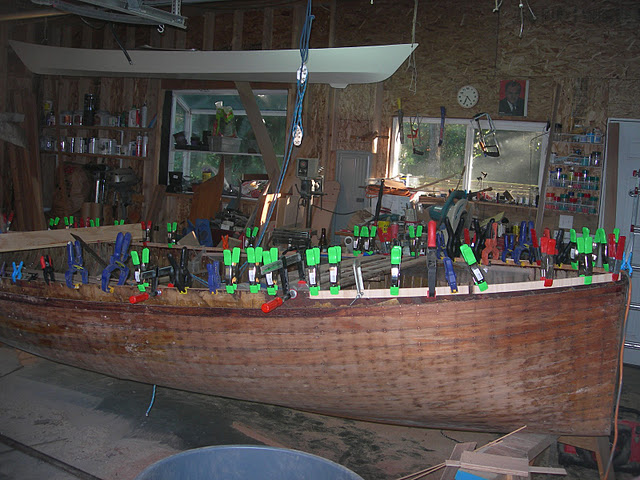
Gordon Douglass Boat Works - George Ford had recruited Sandy Douglass to the class in 1938 when some of the Rochester Y.C. 14 fleet attended the Put-In-Bay regatta. Sandy would shortly begin building "bones" 14's in his shop at Vermilion Ohio, the "Fishhouse"; building them to the full Uffa spec. Again it is unclear how many he made but it is probable he only built them for three years. He, like Volney Lacey, found the Uffa building method too time consuming to make any money. Sandy estimated that, to build one "bones" 14, to hammer the double planking to the ribs and then clench the nails, took 70,000 hammer blows! Sandy's "bones" 14's were considered stiff and down to weight.

It is highly likely, (though I haven't confirmed it by measuring his boats) that Sandy was building his "bones" 14 to Uffa's Alarm lines and not to the older R.I.P lines. (See the comment by Stephen Smith to this post.) Sandy was a very good friend of Uffa from their time competing in the sailing canoes. In 1935, the same year George Ford was trying to get the Americans going with the R.I.P design, Stewart Morris had appeared on the English scene with the faster Uffa Alarm. It wouldn't surprise me if Uffa happily provided Sandy with the lines to Alarm when Sandy let him know that he intended to build International 14's.

[ed. note - I don't have a copy of Sandy Douglass's book, "Sixty Years Before the Mast" though I did peruse it some time ago. Some of the questions may be answered in his book.]

Existing known 14's of each builder -
  • Rochester Boat Works - US 5 Eddystone Light - Mystic Seaport Museum, CT.
  • ACE Boat Works - US 79 Chit - Mariners Museum, VA.,  US 34 - Restored Lake Wanaksink, N.Y. - bought from Cape Cod Shipbuilding -
  • Douglass Boat Works - US 112 - Mark Woodard, WA.
Existing bones 14's of unknown lineage -


Tuesday, March 20, 2012

U.S. One-Design # 269

I had just got off the phone with George Moffat, who had modified and raced USOD US 268 in the mid 1950's, when I turned back to the computer and found an email about the next 14 in the number sequence, USOD US 269, built by Pat Curtiss in Erie Pennsylvania, in 1947.

From Pat's email:

"Here are a couple of photographs of US 269 which a friend and I built in high school from a Douglass and McLeod kit in 1947 in Erie, PA . The kit came with the centerboard case installed, so the difficult carpentry was done. We did all the rest . It was quite a surprise to the local small boat sailors to see the impressive performance of this boat. We sold the boat in 1952 and I don't know its fate.

By the way, the picture on Mar 2 of the interior is not a Douglass and McLeod model which was very similar to the Thistle, with a number of lateral slats forward near the mast step, and a number of lateral slats aft near the transom. There were two flotation tanks, one forward of the mast and the other just forward of the transom.

US312 was also in Erie PA in 1948 but we were never able to get a larger class going. We did race the boat at Put-in-Bay, OH a number of times."

Interesting about Pat's comments on the standard interior layout of the Douglass and McLeod One-Design. I do know that finishing off the shells, as Pat and his friend did, was a common way to get into the International 14 class in the 1940's and 1950's, and with all the amateur completions, there may be a wide variety of interiors. The interior layout I featured in a previous post as being of a One-Design was typical of the Uffa 14's being built in the late 1930's and was carried over to the early Fairey Marine 14's in the late 1940's. Come to think of it, the photo in that previous post may be a early Fairey Marine 14 and not a US One-Design. Oops! (After some thought, I've corrected that previous post.)

The two pictures, Pat sent along:


Tuesday, March 13, 2012

USOD # 370 Re-emerges - Slightly worn but restorable

Yarrow Thorne from Providence R.I. emails:
"I just picked up hull 370 today and hope to have the boat ready for display at the worlds in Toronto 2013........ I am looking forward to bringing back a classic."
From the pics, looks like USOD # 370 has spent a lot of time propped up on the starboard gunwhale, a long enough time that gunwhale is completely gone and the veneer on the sheer has deteriorated. Also, the interior seems to have disappeared; the thwart looks to be a modern afterthought. It's obvious Yarrow is starting from a basic shell, but, all in all, looks like a good project.


Saturday, March 10, 2012

USOD # 360 Sails Again

Paul and Yvonne Galvez got their newly purchased USOD # 360 on the water last weekend (not sure where in Southern California it was, but there are some spectacular cliffs in the background). Paul's email was bubbling over with enthusiasm at sailing this newly rediscovered gem:

"Finally had a chance to put the old girl through her paces... I'm impressed. The boat is lively and very responsive. Even though she is tame by today's standards, it is still an athletic boat and demands precise trim for optimum speed and height. Believe it or not, the sails are original Ratsey and Lapthorne from '47. They are a bit blown out compared to what I am used to but in extraordinary shape nonetheless, with very little wear. This boat does not have any weight in the centerboard. No jib sheet cleats either. We got it planing in about 15 knots true and relatively flat seas. The vang exploded on a power reach but everything else held up fine.

She is getting a makeover now and will be beefed up at the mast partner, bulkheads,  dagger board trunk, and of course the vang. We do not want anymore explosions... Plans are to also replace the hiking straps and buoyancy tanks, along with some aesthetics. She should hopefully be ready to go by Summer. There is already talk of shipping her to Toronto for a vintage regatta that may take place during the 14 Worlds next year. Stay tuned."

And the pics of USOD #360 bombing along, spray flying after spending decades in a garage:


Thursday, March 8, 2012

US One-Design Classic International 14 (Part 2)

Southern California becomes the center of the USOD class

Somewhere in the late 1940's the nexus of U.S One-Design International 14 fleet activity (the one-design now switched from the R.I.P. design to the Douglass and McLeod hot molded Uffa Fox Alarm hull shape) moved from the Rochester fleet to the Southern Californian fleet. And as one dynamic mover-and-shaker exited (the founder of the US International 14 class, George Ford of Rochester, retired from 14's and started another successful yachting career on the Great Lakes in a Sparkman and Stephens designed yawl), another one emerged, a Southern Californian, Dick Fenton, the Commodore of Balboa Yacht Club, Commodore of Southern California Yachting Association, and by 1948, president of the nascent U.S. International Fourteen Association.

Details of the rise of the Southern Californian USOD fleet are somewhat sketchy; it would be best to first go back and reread the excellent early Southern California history as put down by Peter Gales. It is at the 1948 "International Championship Regatta", hosted by George Ford and the Rochester Yacht Club, that the Southern Californians demonstrated how strong a one-design International 14 fleet they had organized in three short years. Six Californian 14 teams made the cross-country trip out east and they left with the majority of the prizes.

What do we know about the USOD from the  1948 "International Championship Regatta"?
  1. A one-design rule had already been hammered out by 1948, as the regatta was split into two series; a three race series for the US One-Designs and a three race series for the "Open" International 14 (the Canadians were having none of this one-design; led by Charlie Bourke, they were happily developing new designs - also being hot molded). The USOD fleet met the requirements for the 'Open" rule (the English 14 development rule) and sailed  for the "Open" series trophies as well.
  2. The one-design rule allowed lighter 14's than the open rule as some of the USOD's had to carry correctors to meet the 225 lb. hull weight minimum when racing in the "Open" rule.
  3. In the light air to drifter series, the 1935 Alarm hull of the USOD would prove as fast as anything designed up to that point; five of the USOD's scoring better in the "Open" series than Charlie Bourke's 1944 'Conneda". (This was nothing out-of-the-ordinary as, much later, a re-rigged USOD would win a light air regatta in the 1970's against the latest Kirbys and Proctors.)
  4. Obviously Douglass and McLeod was selling the USOD, either as a hull or a complete 14, to anyone who wanted to front the money. Since the USOD was the only 14 game in town for the United States in the late 1940's, the Douglass and McLeod USOD filtered into the East Coast - besides the fleet in Rochester there was a small fleet in Essex Ct -,  though the majority of boats were going west to the burgeoning fleet in Southern California. The East Coast, like the Canadians, would never buy into the one-design rule, but (and this is where the confusion comes from) the Douglass and McLeod Alarm hulls would always be referred to as the U.S. One Design (USOD), or One-Design for short, even though, on the East Coast, they would never be raced as a one-design.
Below is the somewhat famous photo of the kingpin of the early Southern Californian USOD fleet, Dick Fenton, in his Douglass and McLeod number 116 (note the caret symbol under the 14 insignia - designating this 14 as a one-design), sailing with a reef in the main.


(To be continued.)

Sunday, March 4, 2012

U.S. One-Design Classic International 14 (Part 1)

U.S. One-Design International 14 - Pre-WW II and immediate Post-WW II

There is considerable confusion when I write about the U.S. One Design International 14 (this being the most common Classic International 14 hull being found for restoration). The International 14 has always been considered a development class. but there was a period before WW II, and the decade after WW II,  that major areas of U.S. 14 activity were sailing the 14's as a one-design, with their own rules. (As an aside, U.S. International 14 history is peppered with one-design classes that come directly from the International 14, such as the Jet 14, the Gannet dinghy and, more recently (1990's), another class called the One Design 14, based on the Jay Cross Mk 3 hull, built and marketed by Peter Johnstone.)

The history of the U.S. One-Design International 14 class starts pre WW II, in 1936, right at the beginning, when the founder of the U.S. International 14 class, George Ford, had local boatbuilders producing ribbed copies of the Uffa Fox "R.I.P" design in and around Rochester, New York. George Ford noted the success of American one-design classes of that period (the Snipe, Lightning, Comet, Star) and reasoned it would be better to get this new International 14 class, based on the English rules, off the ground in the U.S. as a one-design hull. George Ford's desire to mass produce a one-design 14 was immediately hamstrung by (in copying from Uffa Fox), the very complicated method of building these "R.I.P" hulls (double planked, about 80+ steamed ribs, thousands of copper rivets). George never quite solved the problem of meeting three criteria at the same time; how to build a "R.I.P." 14 down to weight, strong enough and, given the labor intensive construction, how to build them at a profit. It's hard to determine how many of these R.I.P copies were built (20, maybe 30). In 1938, the Rochester group ran into Sandy Douglass from Ohio at a Put-In-Bay regatta and shortly after that, Sandy Douglass started building ribbed 14's to a more modern and faster hull design than "R.I.P", that of Uffa Fox's later "Alarm" design ('R.I.P" being designed by Uffa in 1931, "Alarm" being designed in 1935). How many ribbed "Alarm's" Sandy Douglass built is unknown. (I've seen the total number of U.S. ribbed 14's built, both "R.I.P" and "Alarm" hulls pegged at 37, but this may be conjecture).

After WWII, around 1945, Sandy Douglass, now in partnership with Ray McLeod Sr, started producing both his famous Thistle sailing dinghy and the "Alarm" design International 14's using the hot molding ply veneer process developed during WW II. (The hull shells were molded by U.S. Molded Shapes in Grand Rapids Michigan - formerly U.S. Plywood - and then trucked back to Vermillion Ohio for completion.) Given the ability to mass produce hot molded ply hulls, the hull of choice for a One-Design International 14 now switched over to the Uffa Fox "Alarm" design. The Rochester fleet, already solidly pro one-design, was now to be joined by another fleet as one-design proponents; the new, upstart International 14 fleet in Southern California. (to be continued.)

Sunday, January 29, 2012

From Carbon, Back to Hot Molded Wood

2011 U.S National Champ, Paul Galvez, (in the modern hi-tech International 14's) shot an email over to "Old 14er Central" about his surprising latest International 14 purchase.
"We just recently purchased a Douglas One Design, USA 360 built in '49. It's in surprisingly good shape and we intend to complete a restoration of her true to her era. If you have any info about this particular boat, please let me know. Any info about the Douglas One Design including photos of rigging and deck layout would be much appreciated. We are also consulting with our west coast elders for any info to make sure the restoration is accurate."
 Paul didn't detail who the "We" was in the team behind this purchase. I checked the records and US 360 isn't listed. The date of 1949 looks correct though (I have records on US 332 and US 390 as both being built in 1949). It does look like there is, on the West Coast, a considerable amount of restoration on International 14's that were built just post WW II. Perhaps a vintage gathering down the road?

Paul, two wire blasting in his modern International 14.................


US 360.... looks from the photo that Paul picked up a complete vintage 14 thats ready to go......


Tuesday, November 22, 2011

Two Classic 14's in the Marketplace

Got this email from Bill Barringer;

"I too started sailing International 14s at 13 in 1962.  I currently have two and am looking for a home for them.  One is US970, John Carcich's McCutcheon Kirby V, and  US226, a D&M Int 14 One Design.  US226 is almost complete and original.  (Wood lead centerboard a la a Thistle.) "
If you have some interest, contact me to get Bill's email address (Go here and click on my email contact information.) Hopefully he will send some pictures along.

I have some stories to tell about John but I'll save it for another post.

Saturday, November 19, 2011

Two Pictures; US 116 and Sailing in Annapolis Harbor

Two pictures (click inside any picture for slideshow); The first picture Mark Woodard found on the Internet. US 116 is presumed to be a hot molded Sandy Douglass/Uffa Fox Alarm hull.


A picture in Annapolis Harbor. Looks to be frostbite sailing back when there were no drysuits or wetsuits. Skipper and crew unknown. Hull design unknown. Looks to be in the early 1960's.


Friday, November 11, 2011

Pics of US 112

All pictures by Mark Woodard. Click in one of the pictures to start a slideshow.


US 112 in Mukilteo Washington

Mark Woodard writes;

I bought #112 a little over a year ago and set out to maker 'er sail again. The boat was largely complete, but was in pretty worn shape. It was a basket, a double-planked hull with "oiled silk (think umbrella) between the layers to give it an hint of being water tight. She was a basket. When I grabbed hold of the transom and gave it a jerk you could see the entire boat flex this way and that.

I soon realized that to "restore" the boat to using its original construction methods - 7,500+ copper clinched nails into 83 steam-bend ribs - could never be accomplished in my life time. So, I decided "rebuild" the boat using West System epoxy and turn it into a practical, sailable boat for 1-2 people. BLAPHOMEY (sp?)! When I first broached the approach on a wooden boat blog I thought they'd hunt me down and crucify me!

Please feel free to use my photos. I'd love to know who built my boat and when. I suspect that it might have been built by Sandy Douglass before the much more cost-effective hot-molding process came along, but I can't be sure. Two distinguishing features on my boat: The next to the closest plank next to the rail was (and is) a contrasting, darker color. Also, the sail insignia doesn't have a straight line under the 14, it's more of a mushed "caret" - a shallow "V". Any and all information on the origins of "Maureen" - my departed Grandmother - would be greatly appreciated.

My reply;

I looked in my archives. US119 was built in 1940 by Sandy Douglas and was listed as a Uffa One Design (this was the Alarm hull design that would become the basis of the Jet 14 class). I would think your hull is close in age to those dates.

The latest Woodenboat has a continuing series on Uffa Fox. I didn't realize that Sandy Douglass beat Uffa to hot moulding hulls. Sandy Douglass wrote an autobiography "Sixty years before the mast". I haven't read it but I did check Wikipedia which has Sandy getting into boatbuilding in 1938. Int 14 US 112 was built in the pre-war Uffa Fox method, diagonal planking sandwiching a waterproof fabric inner layer so if you have a Sandy Douglass boat, it was one of the early ones that Sandy built.

The assumption is that Sandy used Uffa's building methods until he was able to utilize the WWII developed hot moulding techniques. I think there are probably some people out there that know Sandy's history better than I. I wonder where Sandy's archival history went?

Friday, June 10, 2011

Note from Steven Smith about Douglas and McLeod Int. 14's

Received this note from Steven Smith of California, who is looking for a Douglas and McLeod International 14 to restore.

"I've been trying to research the Fourteens of the 1940's and 1950's, those my Dad refers to as the Douglass one-design 14. I would just love to find one of Douglass' molded plywood 14's to restore and sail.

I grew up sailing the Thistle, crewing with my Dad starting at age 8. I sailed with him until I finished college and my sister took over my spot on the boat. We did plenty of restoration work on the old woodie Thistle, of course also built by D&M, including new rails and re-fitting the centerboard trunk. Its still one of the fastest Thistles around. Now at age 54, I find myself back in the middle spot on the Thistle again. I love the way the boat sails, but for my own boat, I can't muster a crew of 3, and the Thistle is just a tad too big and heavy to fit in my side yard.

So, my mind wanders to how wonderful it would be to have one of the old molded plywood 14's, perfect for me and my wife in light to medium air, and with a big friend in heavier wind. In a perfect world there would be enough of these beautiful old boats around to race each other, but I would be content with just the delight of an afternoon sail. Actually, I suspect the local Thistle fleet would be happy to have me race with them.

As I understand, D&M made 175 molded-hull 14's (?). They are no doubt mostly rotting under canvas tarps in barns -what a shame. I'll bring one back to life if I can find one. Do you have any ideas at all on where one could be found? How to even look? The current class seems so far removed from those boats that they hardly seem aware of them, and certainly don't appreciate them. What they call a 'classic' is still a modern fire-breathing beast compared to the non-trapeze boats. The vintage wood boat movement in the UK seems to do better, but of course they would not
have any of Douglass' boats.

Also, there is a book from England that is referenced but I can't find a hard copy, T.J. Vaughan's "History of the Fourteens, 1923-2003" or something like that. Any chance you might know where or how to get a copy of the book? The text is online, but apparently the book has pictures, drawings, figures.

I'm on the west coast, San Jose, CA. but I wouldn't mind traveling east if I needed to find a boat. Anyone local in the west you know of with a classic that I could meet and chat with?

Any help or suggestions you may have would be appreciated."


If you can help Steve, leave a comment to this post, or email me at the address found over in the "About Me" section