Showing posts with label 1930's. Show all posts

Wednesday, September 23, 2020

Four Early Canadian 14's


North American International 14 history kept trickling in during my hiatus at posting to this blog. Interesting history of four early Canadian 14's popped up over the last three years.


KC-166

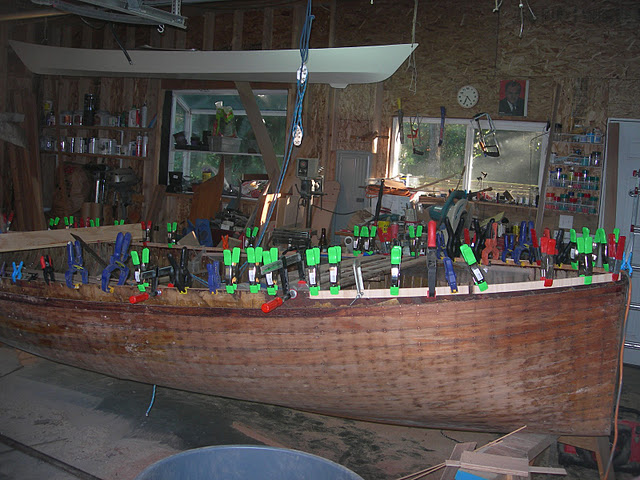
Mark Merritt has been pursuing the history of his Corneil International 14 and reached out to Rob Mazza, Canadian International 14 historian, who sent this email and photos of Peter Jarvis's Corneil, KC-166. From Rob's email:
"I finally heard back from Peter Jarvis, who I ran into at the Toronto Boat Show in late January. He sent me the attached photo and note on his George Corneil Fourteen KC 166 from 1956. This was the 2nd to last 14 built by George Corneil. So that KC 142 sail number on the battens in the boat may not be that improbable!

I have in my records:

KC 127 - Nimbus - Paul McLaughlin - 51 Bourke
KC 133 - Moonbeam - Harvey Bongard, Bruce Kirby Harry Jemmett - 51 Bourke
KC 144 - Wee Irish? - Bud Whitaker - 54 Bourke
KC 166 - - Peter Jarvis - George Corneil - 1956
KC 173 - Soo-perb - Mike Pruett, Dick Vine? - 1st Proctor 1 in Canada - 1954 in England?

Mark, there seems to be no question that the boat you have is indeed a George Corneil, and probably dates from the early 1950s, and may well be the 3rd to last Corneil built if the 142 sail number is to be believed.

Rob"

Peter Jarvis KC-166

And Peter's note to Rob  Mazza.


KC-5

Maureen Flagler sends along photos and a history of two Bourke "bones" boats that have been in their family, KC-5 and KC-25.
"My sister... was able to find some photos. In addition she has attached photos of an earlier I14 that my Mother and Father sailed from Ottawa during WWII. It was originally named Alisada and renamed to Eagle II. The registration for that one is KC5. We don’t know when that boat was sold or to whom."


KC-25

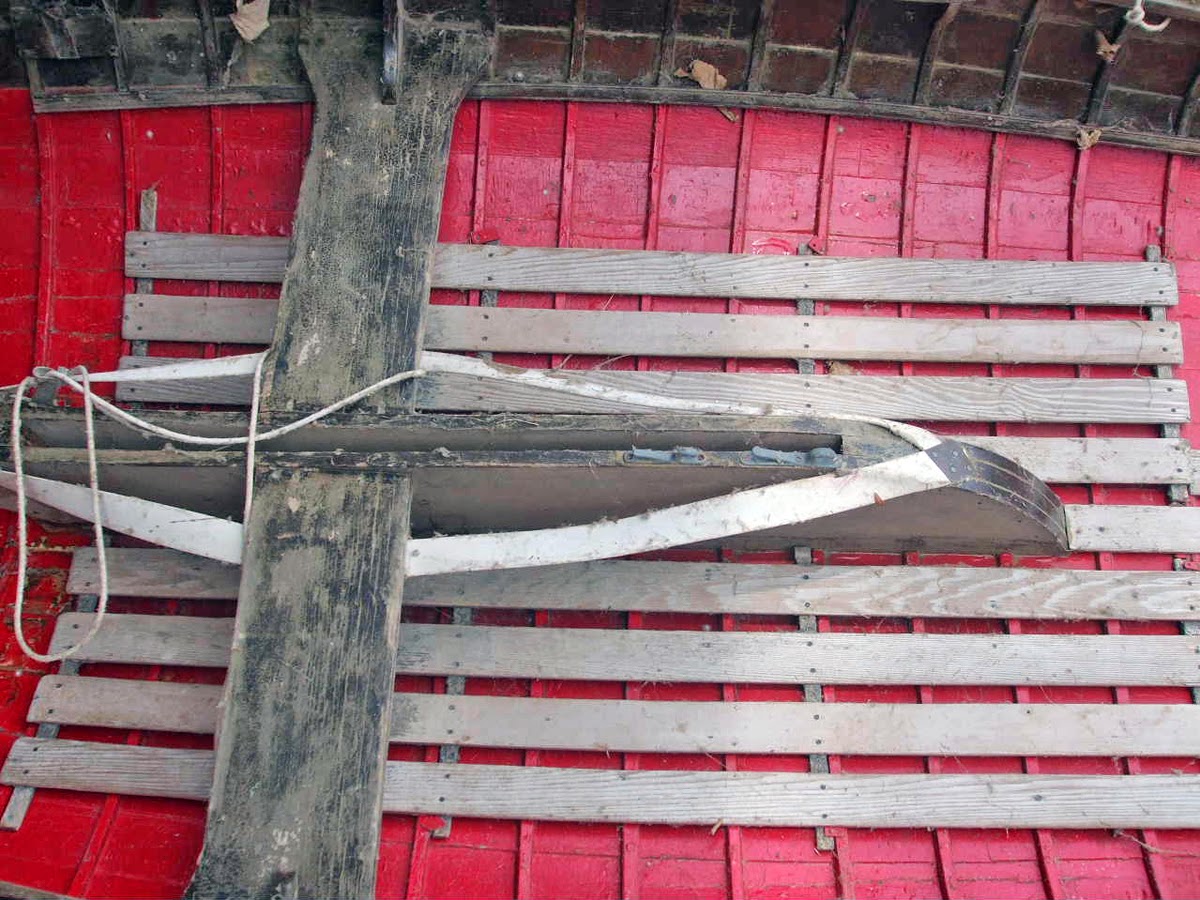
"After the war, our parents lived in Oakville and we believe the Chinook (KC25) was built there with Bill Gooderham... We think he is from the Gooderham family of Gooderham and Worts Distillery. KC25 (Chinook) has small ribs throughout the interior. The photo shows the interior of Chinook – KC25."


Maureen says that KC-25 was last splashed into the water in the 1980's. (The date that this photo was taken.)


KC-26

Ryan Grinnell from Toronto Canada sent this email and photos about a famous Canadian 14.
"...International 14 that has been in my family for over 50 years. Her name is Conneda and I even saw a reference to this name linked to Charlie Bourke. Could this be the same boat? The sail number is US 424 and according to my dad, via my late grandfather, it was the first molded plywood I14."


Ryan Grinnel's grandfather sailing.

Again, from Rob Mazza's International 14 history, published in the RCYC newsletter, we have the history of Conneda.
"In 1946, with the help of Prof Parkin and technician Jack Noonan (a Brittania member and dinghy sailor, as was probably Parkin). the National Research Council hot-moulded three Bourke designed 14's and, according to Kirby, a very special fourth one for Bourke himself, called Conneda. Her clean rib-less interior was admired by all. "You don't take a sponge on board, just a duster," said Paul McLaughlin. The first three boats stayed in Ottawa to further build that fleet, while Conneda went to RCYC and was later sold to sailmaker Colin Ratsey in New York."
My records indicate that sail number US-424 was indeed registered to Colin Ratsey, so it is a good bet that Ryan Grinnel's family does indeed own the famous hot-molded Bourke "Conneda".


From Tom Vaughn's International 14 history, here is a photo of Conneda. Certainly the most naked 14 ever. There couldn't be a more stark difference between the Uffa and Bourke "bones" 14's of the pre-war era and this new-fangled hot-molded 14.


Sunday, April 16, 2017

Rare 14's up for auction in the U.K.


Mike Scott sends along this link to a bevy of rare English 14's being auctioned off this June. A bunch of late 1920's, 1930's Uffa bones 14's in this collection

A list from the announcement:
  1. Clover - K232 Morgan Giles Teak. Stewart Morris's 21st birthday present.
  2. Alarm - K347 Very famous boat raced by Stewart Morris.
  3. Encore - K847 Kirby 2. Stewart Morris last boat. Has been modernized. Very good condition.
  4. Lightning - K290 John Winter's boat.
  5. Taiyara - K396 This boat is in First class order
  6. Corona - K374 Steep rise of floor. Very good river boat. Pretty good condition.
  7. Imp - K170 Very early International 14 which is very similar to Uffa Fox's own Avenger. Imp has been restored to a very high standard by Colin Henwood.


Tuesday, August 2, 2016

Peter Scott Painting of the 1934 Toronto Team Races


Cambridge University Cruising Club Collection

I found this Peter Scott painting over at the Cambridge University Cruising Club website (their history section is a very good read). It is a painting of one of the 1934 Team Races in Toronto with the English team featured prominently in the foreground, and the racers seemingly caught out in one of those Lake Ontario line squalls. The 1934 Team Races would mark the beginning of U.S International 14 class. George Ford from Rochester would try to buy the Uffa Fox R.I.P. from Stewart Morris in Toronto. For some reason the deal could not be completed in Toronto and R.I.P was shipped back to England. George Ford and a syndicate from Rochester were able to complete a deal in the fall/winter of 1934 and R.I.P was shipped again, over the Atlantic, to Rochester N.Y..

I reprint the text accompanying the Peter Scott painting from the Cambridge University Cruisng Club website:

"This is a photograph of an 80 X 50cm painting of "dinghies racing on Lake Ontario" according to the CUCrC Annual Report of the time, which records Peter Scott's gift of the painting in the Club's year of 1935/36. In 1934 a team of 4 UK International 14ft dinghies and sailors (including Peter Scott), from the Royal Norfolk and Suffolk YC, went to Toronto to sail against a team from the Royal Canadian YC and a US team from Rochester YC, New York. The UK beat the US 3-0 and Canada 3-1 to take home the trophy, and Canada beat the US 2-0 (one race being abandoned due to the time limit expiring). There was also an open race for the Wilton Morse trophy which was won by Peter Scott in Eastlight. The series, which had started in 1933, went on to become an international biennial event, interrupted from 1940 to 1958 by WW II.

"The picture was painted in the year after the event - presumably from memory, notes and sketches made at the time, and possibly a photograph - because Peter is shown in the race. The scene is a start (a Preparatory Signal is flying), but only 6 boats are included. The three UK boats are K290 (Lightening - John Winter); K267 (R.I.P. - Stewart Morris); and K318 (Eastlight - Peter Scott). A fourth UK boat, K322 (Canute - David Beale, not a CUCrC member), and an opposing boat are missing from the scene - possibly a deliberate omission because Scott intended the painting for the CUCrC and wished to celebrate the achievement of the CUCrC members on the team. Of the team, three helmsmen and two crews were CUCrC members, one crew was a Cambridge Rugby Blue, and one was an Oxford University YC member. Further details are given in a document accompanying the painting, also available from the Alumni Administrator, and in the Club's archives at the University Library - along with printouts of the articles mentioned below.

"The origins and development of the series are a fascinating part of dinghy sailing lore, well recorded in the history section of the International 14 Class website...; pages 70-74 of 'Uffa Fox's Second Book' (which gives the results of the 1934 races when Uffa was Team Manager); and two articles on Canadian 14 history by Rob Mazza in the Royal Canadian YC 'KWASIND' bulletins of August and September 2013. '14' dinghies evolved in parallel in the UK (where the International Rule was formulated), the US, and Canada. The Canada and America's Cup events of 1930 initiated some animated discussion, between leading sailing figures of the time, as to the relative merits of the UK, US, and Canadian 14 dinghies. The outcome was that Sir John Beale, Commodore of RN&SYC, undertook to organise what became the 1933 international team racing event at Seawanhaka Corinthian YC, Oyster Bay, New York, and then accepted the invitation for the UK to attend the 1934 event at the Royal Canadian YC, Toronto.
From the Louise Ann Ford collection is this 1934 news clipping showing R.I.P (destined to be U.S. 1) sitting on a dock in Toronto with the spinnaker drying.

Louise Ann Ford Collection

Monday, August 1, 2016

2016 Aykroyd Catboat Regatta This Weekend

I just got off the phone with Brett Somerville from the Juniper Island Store who confirms that the 2016 Aykroyd Catboat Regatta on Stoney Lake, Ontario is this weekend, August 6 and 7. The Aykroyd "cottage" 14-footer was part of the L.S.S.A 14-footer class, the dinghy class that was the predecessor of the International 14 dinghy, primarily in Canada but also in Rochester, New York. The Stoney Island cottagers, led by Hugh Drake and Jay Matthews, have been busy restoring these pre-WW II cat-rigged dinghies since the 1960's and now have a robust fleet of around 15 of these lapstrake beauties out for weekend racing. I'm working on getting some contact with fleet members so I can fill out more details of this interesting historical collection of dinghies.

I've pulled some photos from the 2015 Aykroyd Championship, taken by Nick Glas, which I found on the Web and will repost them shortly.

Click here to view some of the other posts about the L.S.S.A 14-footers on the CBIFDA blog.

Wednesday, July 20, 2016

U.S Builders of the 1930 Bones International 14's


My research has uncovered three U.S. builders of the Uffa Fox inspired "bones" International 14's prior to WWII.

Rochester Boat Works- Volney Lacey and his boat-building business, Rochester Boat Works, would build the first 11 R.I.P. copies, 6 in 1935, and 5 in 1936. Volney Lacey's boat yard was in close proximity to the Rochester Yacht Club, and since 1917 had been building fast runabouts, and providing a full service yard for the yachting elite of Rochester. He was a natural choice when George Ford went looking for a builder of R.I.P. copies. Volney took a look at the exquisite construction of the Uffa built R.I.P. and decided he couldn't duplicate it and also make any money from building these new-fangled 14-footers. He changed the spec, putting in larger ribs at a greater spacing, and eliminating the small seats of the Uffa 14's, adding the stiffness back in by building a wide gunwhale plank where the crew sat (he got around the rule by cutting 3/4" slots to make it an "open" boat). The Rochester Boat Work's R.I.P. copies were not considered fast. Norm Cole called them "crude" and they were most likely heavy. Volney Lacey would not make any more R.I.P. copies after 1936, citing an inability to make a profit even at the reduced spec. But George Ford had already located another builder.

A.C.E. Boat Works - Starting in 1937, the Rochester fleet would get their R.I.P. copies from an obscure boat-builder in Syracuse, New York. George Ford selected Albert F. Englert, who, with his brother Clarence, had been building small runabouts since 1930. Albert also had a good reputation for building fast Snipes. It is unclear how many R.I.P. copies Albert and his brother produced (some estimates are 12-18) but it appears he built them from 1937 - 1941. He also supplied hulls to Cape Cod Shipbuilding, most likely starting in late 1939. (Cape Cod Shipbuilding was advertising their International 14 for the 1940 New York Boat Show.) Norm Cole remembers they were built to the "R.I.P. spec" but were also very flexible. He relates that you could grab the forestay on an Englert 14, wiggle it back and forth, and watch the transom dance. The Englert R.I.P. 14's were down to weight (225 lbs) and fast enough, George Ford would pilot the first one, US 11 Venture to an unbeaten season among the Rochester fleet in 1938.

Gordon Douglass Boat Works - George Ford had recruited Sandy Douglass to the class in 1938 when some of the Rochester Y.C. 14 fleet attended the Put-In-Bay regatta. Sandy would shortly begin building "bones" 14's in his shop at Vermilion Ohio, the "Fishhouse"; building them to the full Uffa spec. Again it is unclear how many he made but it is probable he only built them for three years. He, like Volney Lacey, found the Uffa building method too time consuming to make any money. Sandy estimated that, to build one "bones" 14, to hammer the double planking to the ribs and then clench the nails, took 70,000 hammer blows! Sandy's "bones" 14's were considered stiff and down to weight.

It is highly likely, (though I haven't confirmed it by measuring his boats) that Sandy was building his "bones" 14 to Uffa's Alarm lines and not to the older R.I.P lines. (See the comment by Stephen Smith to this post.) Sandy was a very good friend of Uffa from their time competing in the sailing canoes. In 1935, the same year George Ford was trying to get the Americans going with the R.I.P design, Stewart Morris had appeared on the English scene with the faster Uffa Alarm. It wouldn't surprise me if Uffa happily provided Sandy with the lines to Alarm when Sandy let him know that he intended to build International 14's.

[ed. note - I don't have a copy of Sandy Douglass's book, "Sixty Years Before the Mast" though I did peruse it some time ago. Some of the questions may be answered in his book.]

Existing known 14's of each builder -
  • Rochester Boat Works - US 5 Eddystone Light - Mystic Seaport Museum, CT.
  • ACE Boat Works - US 79 Chit - Mariners Museum, VA.,  US 34 - Restored Lake Wanaksink, N.Y. - bought from Cape Cod Shipbuilding -
  • Douglass Boat Works - US 112 - Mark Woodard, WA.
Existing bones 14's of unknown lineage -


Sunday, July 17, 2016

Seattle Fleet Numbers from 1950 to 1963

View below in PDF format. It is best to put the file in another tab on your browser for viewing. Click on the pop-out icon (box with an arrow pointing to the right) on the top right of the PDF box to put the PDF file in another tab.


Friday, July 15, 2016

US 107 - Another Bones 14 Uncovered on the West Coast

Paul and Yvonne Galvez stumbled on this stunning vintage 14 - a bones 14 on the West Coast (bones is the term I use for the Uffa Fox inspired construction of the 1930's International 14's - lots of internal ribs or "bones"). It is undoubtedly an historic U.S. 14 but. given the paucity of information on the early U.S. 14's, this find will now force the I-14 history nuts to try to track down her origin. Paul and Yvonne are the new owners and Paul is busy measuring and documenting the hull. It came with two sails, one with number 104 and one with number 107 - the 107 sail being a Cowes Ratsey and Lapthorp, circa 1939.

The hull is in great shape given her age.


Click here to view US 112, Mark Woodard's bones 14 in Seattle.

Thursday, July 14, 2016

Aykroyd on Ebay

Tom Price sends along an L.S.S.A 14, an Aykroyd, his eagle eye spotted for sale on Ebay.

A nice restoration but the rig is off. The lake Aykroyd's were gunter rigged, not gaff rig. This looks like a modification to the original.


Upadate: August 2, 2016: This Aykroyd is now on Craigslist. $4900 is not a bad price for a complete restoration but the market is tiny. This dinghy is located in Raleigh, NC of all places. Her name is Bijou.


Monday, August 24, 2015

Charlie Bourke's Riptide on Toronto Docks

From the Toronto newspaper, The Mail and Empire, a photo of Charlie Bourke's Riptide sitting on the docks during the 1934 Team Races with the English and Americans. The photo definitely shows that Riptide was still a LSSA 14-footer though, probably at this point, sailing with a sloop rig instead of a cat rig.


Friday, August 21, 2015

Charlie Bourke Models


Charlie Bourke, courtesy of the Canadian International 14 Newsletter

Some may consider Charlie Bourke as Canada's greatest 14-foot dinghy designer (even surpassing Bruce Kirby, but that may elicit some arguments!). Charlie designed and raced both the LSSA 14-footers and the International 14's and his post war International 14 designs dominated Canadian racing up into the 1960's when the Kirby designs took over. His design career spanned over 35 years and he was the instrumental mover and shaker that converted the Canadian LSSA 14-footer over to the International 14 class in the late 1930's. His victories and membership in Canadian teams are too numerous to document here.

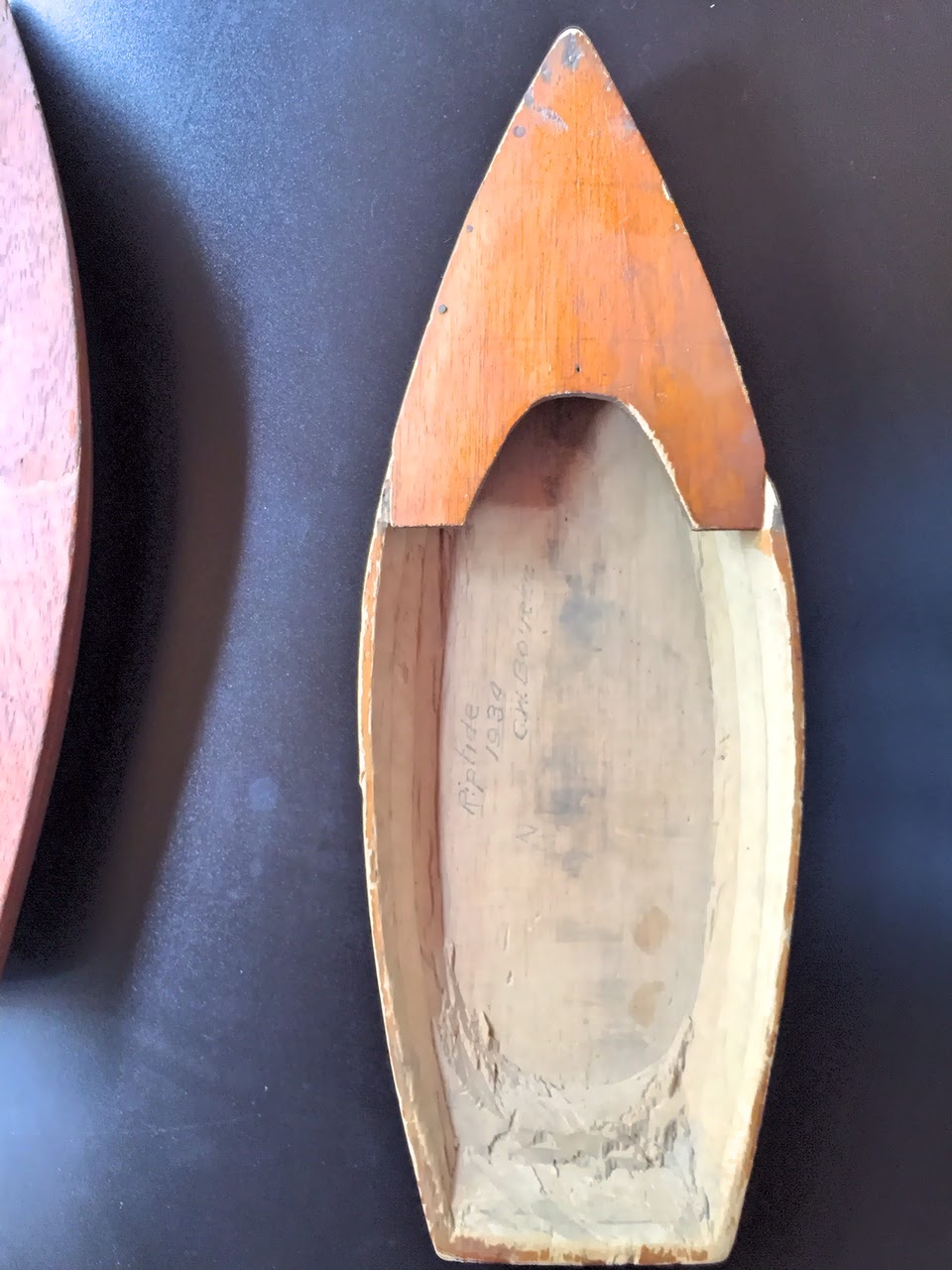
Scott Kerr, who is married to Charlie Bourke's grand-daughter, Meghan, sent along some photos of two of Charlie Bourke's own hand carved models. They are of interest because these are designs Charlie was doing after competing against the Uffa International 14's at Seawanhaka Y.C, 1933. One model of Riptide is dated 1934, the year after the Seawanhaka Team Races. Here is my reply to Scott Kerr:

"The Seawanhaka Team Races, where the English and the Canadians and the U.S (Seawanhaka club members) raced the LSSA 14's and the English International 14's against each other, was held in Sept 1933. The English came back to race the Canadians and the U.S in 1934 in Toronto. So Riptide is what Charlie was designing after he saw the English open International 14's in 1933 (and to Charlie the two approaches to a 14 dinghy were like chalk and cheese). It is interesting that in 1934 Charlie still maintains the fore-deck as was allowed in the LSSA 14's. The model looks very much flatter than I would have expected. The LSSA 14's were very fine lined dinghies with balanced rocker whilst the Uffa Fox International 14's were broad transom, rocker forward designs."

The 1934 Riptide side view. It's hard to discern from the photograph but it looks as if there is a little bit of flare at the gunwhale.


The 1934 Riptide top view. (Note that Charlie has retained the fore-deck of the LSSA 14-footer, the English Uffa International 14's were open dinghies.)


The inscription on the inside, bottom of the model of Riptide.


The other Charlie Bourke model is definitely in the International 14 design camp. There seems to be some tumblehome which was a characteristic of English Uffa pre-war designs. Rocker has deepened and moved forward.


Many thanks to Scott Kerr and wife Meghan for sending along the photos.


Tuesday, June 24, 2014

Another Mallette Lapstrake 14 has been found

Andre Cloutier of Ravenwood Canoes sends along pictures of an original Mallette International 14. Supposedly four were built around the Gananoque area of Canada before World War II with one known to be, at the present time, in the small boat collection at the Antique Boat Museum. This one has been stored under a cabin somewhere in the Canadian wilds, though it certainly looks like a good candidate for restoration. Unfortunately the owner has not been inclined to sell this Mallette.

I did a post a while back on Simon Watts building a reproduction of the Mallette with an intention of publishing plans at some point.

Some pictures of the current Mallette discovery.


Tuesday, April 15, 2014

Bear Mountain Boats restores a Vintage 14 "Shottie"

I saw online that Bear Mountain Boats, known for strip plank canoes, had a restored pre-war International 14 at a outdoor boat show somewhere in Ontario last year. A very interesting transom which looks quite unlike the Bourke or Mallette 14's I've seen from that era. I sent an email to Bear Mountain last year but didn't get a reply. It's worth another try. A real beauty as can be seen by the photos.


Sunday, July 7, 2013

Simon Watts building an oldie Royal St. Lawrence YC 14

Master boatbuilder (particularly in lapstrake) Simon Watts of Canada sends along some pictures of a pre WWII International 14 reproduction of one he bought back in 1955. From his email:
"Thought you'd like the latest photo on the I-14 I'm building in Nova Scotia. It's an exact copy of one I bought at the Royal St Lawrence Yacht Club (MontreaL)in 1955. The original was probably built (lapstrake) by W.J.Malette in Ontario about 1937. I suspect the lines were derived from Uffa Fox's Alarm. The old boat is beyond economical repair so I built new. The project will be featured in WB magazine (if I live that long) and I plan to publish plans and a building manual.It will be the sixth and final design in the Six Classic Boats series--you'll find it on Google. All good wishes,"   Simon

Simon asks for some information. Here is what my research has pulled up.

There were at least 15 International 14's registered as being built at the Royal St. Lawrence Yacht Club in the 1938 - 1939 time frame. I talked to Ian Bruce and he feels that they were probably built by the boatwright that Royal St. Lawrence Yacht Club employed. (This was not unusual, particularly for the richer Canadian yacht clubs, to sponsor dinghy builds over the winter using their employees.) I also talked to Bruce Kirby and he remembers the first Montreal fleet as being home grown and not as fast as the Toronto Bourke 14's. As far as a Mallette 14, Emmett Smith of the Antique Boat Museum, who has one in their collection, has a record of only four Mallette's being built. My guess is this may be a Montreal copy of the Uffa RIP model that was introduced to jump start the International 14 in North America. It would be interesting for historical purposes to see the lines of the 14 as Simon has drawn up. They may give us a hint at the origin of this 14 design.

Pictures (Simon builds them upright, which I hear is the real way of doing a lapstrake boat):


If you have any more information about the Montreal 14's, add a comment to this post or drop Simon an email:

 simonawatts (with our good friends at) earthlink.net


Sunday, March 4, 2012

U.S. One-Design Classic International 14 (Part 1)

U.S. One-Design International 14 - Pre-WW II and immediate Post-WW II

There is considerable confusion when I write about the U.S. One Design International 14 (this being the most common Classic International 14 hull being found for restoration). The International 14 has always been considered a development class. but there was a period before WW II, and the decade after WW II,  that major areas of U.S. 14 activity were sailing the 14's as a one-design, with their own rules. (As an aside, U.S. International 14 history is peppered with one-design classes that come directly from the International 14, such as the Jet 14, the Gannet dinghy and, more recently (1990's), another class called the One Design 14, based on the Jay Cross Mk 3 hull, built and marketed by Peter Johnstone.)

The history of the U.S. One-Design International 14 class starts pre WW II, in 1936, right at the beginning, when the founder of the U.S. International 14 class, George Ford, had local boatbuilders producing ribbed copies of the Uffa Fox "R.I.P" design in and around Rochester, New York. George Ford noted the success of American one-design classes of that period (the Snipe, Lightning, Comet, Star) and reasoned it would be better to get this new International 14 class, based on the English rules, off the ground in the U.S. as a one-design hull. George Ford's desire to mass produce a one-design 14 was immediately hamstrung by (in copying from Uffa Fox), the very complicated method of building these "R.I.P" hulls (double planked, about 80+ steamed ribs, thousands of copper rivets). George never quite solved the problem of meeting three criteria at the same time; how to build a "R.I.P." 14 down to weight, strong enough and, given the labor intensive construction, how to build them at a profit. It's hard to determine how many of these R.I.P copies were built (20, maybe 30). In 1938, the Rochester group ran into Sandy Douglass from Ohio at a Put-In-Bay regatta and shortly after that, Sandy Douglass started building ribbed 14's to a more modern and faster hull design than "R.I.P", that of Uffa Fox's later "Alarm" design ('R.I.P" being designed by Uffa in 1931, "Alarm" being designed in 1935). How many ribbed "Alarm's" Sandy Douglass built is unknown. (I've seen the total number of U.S. ribbed 14's built, both "R.I.P" and "Alarm" hulls pegged at 37, but this may be conjecture).

After WWII, around 1945, Sandy Douglass, now in partnership with Ray McLeod Sr, started producing both his famous Thistle sailing dinghy and the "Alarm" design International 14's using the hot molding ply veneer process developed during WW II. (The hull shells were molded by U.S. Molded Shapes in Grand Rapids Michigan - formerly U.S. Plywood - and then trucked back to Vermillion Ohio for completion.) Given the ability to mass produce hot molded ply hulls, the hull of choice for a One-Design International 14 now switched over to the Uffa Fox "Alarm" design. The Rochester fleet, already solidly pro one-design, was now to be joined by another fleet as one-design proponents; the new, upstart International 14 fleet in Southern California. (to be continued.)

Thursday, February 23, 2012

Picture of a Pre-War Ribbed Bourke

Peter Sly of the Prince Edward Yacht Club in Picton, Ontario, sends along this photo of a pre-war ribbed constructed Bourke International 14 (probably built in 1936 or 1937). Photo was taken in 1956 on one of the PEYC docks. Those pre-war International 14's were just gorgeous craft (see the rebuilding of US 112).


Wednesday, February 15, 2012

Early pics from the Louise Ann Ford Collection

Start with two photos from Louise Ann Ford:

The first is an early photo with what looks like a teenage George Ford (skippering) with Bill Tarr (relaxing) on a LSSA 14-foot dinghy (decked, single main, lapstrake construction).

Louise Ann Ford Collection

And a picture of both US 1 (the original R.I.P.) and US 2 sailing, presumably out of Rochester. This photo was a frontispiece for a Regatta Announcement by the Danish club, Aalborg. George Ford would take a Rochester team of R.I.P 14's on a European tour in 1936, with stops in Denmark (racing against the Danish 14'ers at Aalborg), Norway and the POW on the Clyde. George was promoting the R.I.P. design as a One-Design and the Danes had built some of their own R.I.P. 14's.

Louise Ann Ford Collection


History of George Ford, from daughter Louise Ann Ford

George Ford was the founder of the US International 14 class. George was a champion sailor in the LSSA (Lake Sailing Skiff Association) 14 class in the 1930's and participated in the International Team Race sailed with both the International 14's (England) and LSSA 14-foot dinghies (Canada and the U.S) in Toronto, 1934. The English team trounced the Canadians and Americans, and George, seeing the writing on the wall, imported the Uffa Fox design R.I.P. in 1934/1935. George then proceeded to set up a boatbuilding operation out of Rochester NY to produce copies of the R.I.P. design . George tirelessly promoted the new 'International 14' class until he retired from 14's in 1949. The original English built R.I.P. was designated US #1.

Louise Ann Ford, daughter of George Ford, has a scrapbook of her father's sailing exploits and is kindly sharing them with the 'Old 14er'.

As I get Louse's material into the computer, I will post them.

Thanks again to Louise Ann Ford for sharing

Friday, November 25, 2011

Another pre-WWII 14

When it rains it pours........

John Kutz from Kirkland Washington sends pics of another pre-World War II Uffa International 14 that he is now in the process of donating to the Center for Wooden Boats. Has the bazillion steamed ribs and the cross planked construction, which I assumed to be early Sandy Douglass construction that copied Uffa (turns out I was wrong, see below). John has no record of the number assigned to this International 14.

UPDATE: After seeing this post, Stephen Smith sent me an email and correctly points out that this 14 IS NOT an Uffa design. Stephen writes;

"Take a look at the shape of the transom. See how rounded the bottom is right down to the centerline. I doubt very much this is an Uffa Fox design, it looks much more like a Morgan Giles design or other from the very late 1920's or early-to-mid 1930's. The Canadians were also building sloop-rigged boats by then, but I think they were clinker-built, so this can't be one of those. It is FOR SURE not a Douglas boat built to Alarm's lines. The bottom is much deeper and rounder. No planing surface on the back. The interior arrangement is also more typical of the Brit's in the early 1930's - not at all like a Douglas boat -- although of course someone could have changed all the interior layout. But the transom shape is a real give-away.

The other Carvel-boat US112 shown from Nov. 11 on the blog is, for sure, one of Douglas' early boats, before he started hot-molding them."
Hmmm..... I wonder what design we have here?

Some pictures;


Friday, November 11, 2011

Pics of US 112

All pictures by Mark Woodard. Click in one of the pictures to start a slideshow.


US 112 in Mukilteo Washington

Mark Woodard writes;

I bought #112 a little over a year ago and set out to maker 'er sail again. The boat was largely complete, but was in pretty worn shape. It was a basket, a double-planked hull with "oiled silk (think umbrella) between the layers to give it an hint of being water tight. She was a basket. When I grabbed hold of the transom and gave it a jerk you could see the entire boat flex this way and that.

I soon realized that to "restore" the boat to using its original construction methods - 7,500+ copper clinched nails into 83 steam-bend ribs - could never be accomplished in my life time. So, I decided "rebuild" the boat using West System epoxy and turn it into a practical, sailable boat for 1-2 people. BLAPHOMEY (sp?)! When I first broached the approach on a wooden boat blog I thought they'd hunt me down and crucify me!

Please feel free to use my photos. I'd love to know who built my boat and when. I suspect that it might have been built by Sandy Douglass before the much more cost-effective hot-molding process came along, but I can't be sure. Two distinguishing features on my boat: The next to the closest plank next to the rail was (and is) a contrasting, darker color. Also, the sail insignia doesn't have a straight line under the 14, it's more of a mushed "caret" - a shallow "V". Any and all information on the origins of "Maureen" - my departed Grandmother - would be greatly appreciated.

My reply;

I looked in my archives. US119 was built in 1940 by Sandy Douglas and was listed as a Uffa One Design (this was the Alarm hull design that would become the basis of the Jet 14 class). I would think your hull is close in age to those dates.

The latest Woodenboat has a continuing series on Uffa Fox. I didn't realize that Sandy Douglass beat Uffa to hot moulding hulls. Sandy Douglass wrote an autobiography "Sixty years before the mast". I haven't read it but I did check Wikipedia which has Sandy getting into boatbuilding in 1938. Int 14 US 112 was built in the pre-war Uffa Fox method, diagonal planking sandwiching a waterproof fabric inner layer so if you have a Sandy Douglass boat, it was one of the early ones that Sandy built.

The assumption is that Sandy used Uffa's building methods until he was able to utilize the WWII developed hot moulding techniques. I think there are probably some people out there that know Sandy's history better than I. I wonder where Sandy's archival history went?