Showing posts with label Bone Boat. Show all posts

Saturday, October 3, 2020

Best in Show: The Galvez's US 104 or US 107


Paul and Yvonne Galvez have been taking their real beauty in International 14 restorations, US 104, Lorelei, a cedar planked, probably an early post-WWII International 14 of mysterious origins, out and about in California. First stop was the modern 2018 International 14 Worlds in San Francisco where the West Coast rag, Latitude 38, named Lorelei the most photographed 14 at the regatta. A most amazing feat given the surfeit of all the new technology; carbon, mylar, racks, double trapezes, gathered at the World Championship.

And in 2019? Best in Show! From Paul's email;
"Last year, we also took her to the Newport Beach Annual Wooden Boat Festival where she received Best in Show. The same show was cancelled this year for obvious reasons but we look forward to next year."
Paul sends along some photos of the all-varnished beauty of  Lorelei on display at the International 14 Worlds in Richmond, California.


Paul and Yvonne accepting the "Best in Show" award at the Newport Beach Annual Wooden Boat Festival.


Wednesday, September 23, 2020

Four Early Canadian 14's


North American International 14 history kept trickling in during my hiatus at posting to this blog. Interesting history of four early Canadian 14's popped up over the last three years.


KC-166

Mark Merritt has been pursuing the history of his Corneil International 14 and reached out to Rob Mazza, Canadian International 14 historian, who sent this email and photos of Peter Jarvis's Corneil, KC-166. From Rob's email:
"I finally heard back from Peter Jarvis, who I ran into at the Toronto Boat Show in late January. He sent me the attached photo and note on his George Corneil Fourteen KC 166 from 1956. This was the 2nd to last 14 built by George Corneil. So that KC 142 sail number on the battens in the boat may not be that improbable!

I have in my records:

KC 127 - Nimbus - Paul McLaughlin - 51 Bourke
KC 133 - Moonbeam - Harvey Bongard, Bruce Kirby Harry Jemmett - 51 Bourke
KC 144 - Wee Irish? - Bud Whitaker - 54 Bourke
KC 166 - - Peter Jarvis - George Corneil - 1956
KC 173 - Soo-perb - Mike Pruett, Dick Vine? - 1st Proctor 1 in Canada - 1954 in England?

Mark, there seems to be no question that the boat you have is indeed a George Corneil, and probably dates from the early 1950s, and may well be the 3rd to last Corneil built if the 142 sail number is to be believed.

Rob"

Peter Jarvis KC-166

And Peter's note to Rob  Mazza.


KC-5

Maureen Flagler sends along photos and a history of two Bourke "bones" boats that have been in their family, KC-5 and KC-25.
"My sister... was able to find some photos. In addition she has attached photos of an earlier I14 that my Mother and Father sailed from Ottawa during WWII. It was originally named Alisada and renamed to Eagle II. The registration for that one is KC5. We don’t know when that boat was sold or to whom."


KC-25

"After the war, our parents lived in Oakville and we believe the Chinook (KC25) was built there with Bill Gooderham... We think he is from the Gooderham family of Gooderham and Worts Distillery. KC25 (Chinook) has small ribs throughout the interior. The photo shows the interior of Chinook – KC25."


Maureen says that KC-25 was last splashed into the water in the 1980's. (The date that this photo was taken.)


KC-26

Ryan Grinnell from Toronto Canada sent this email and photos about a famous Canadian 14.
"...International 14 that has been in my family for over 50 years. Her name is Conneda and I even saw a reference to this name linked to Charlie Bourke. Could this be the same boat? The sail number is US 424 and according to my dad, via my late grandfather, it was the first molded plywood I14."


Ryan Grinnel's grandfather sailing.

Again, from Rob Mazza's International 14 history, published in the RCYC newsletter, we have the history of Conneda.
"In 1946, with the help of Prof Parkin and technician Jack Noonan (a Brittania member and dinghy sailor, as was probably Parkin). the National Research Council hot-moulded three Bourke designed 14's and, according to Kirby, a very special fourth one for Bourke himself, called Conneda. Her clean rib-less interior was admired by all. "You don't take a sponge on board, just a duster," said Paul McLaughlin. The first three boats stayed in Ottawa to further build that fleet, while Conneda went to RCYC and was later sold to sailmaker Colin Ratsey in New York."
My records indicate that sail number US-424 was indeed registered to Colin Ratsey, so it is a good bet that Ryan Grinnel's family does indeed own the famous hot-molded Bourke "Conneda".


From Tom Vaughn's International 14 history, here is a photo of Conneda. Certainly the most naked 14 ever. There couldn't be a more stark difference between the Uffa and Bourke "bones" 14's of the pre-war era and this new-fangled hot-molded 14.


Sunday, April 16, 2017

Rare 14's up for auction in the U.K.


Mike Scott sends along this link to a bevy of rare English 14's being auctioned off this June. A bunch of late 1920's, 1930's Uffa bones 14's in this collection

A list from the announcement:
  1. Clover - K232 Morgan Giles Teak. Stewart Morris's 21st birthday present.
  2. Alarm - K347 Very famous boat raced by Stewart Morris.
  3. Encore - K847 Kirby 2. Stewart Morris last boat. Has been modernized. Very good condition.
  4. Lightning - K290 John Winter's boat.
  5. Taiyara - K396 This boat is in First class order
  6. Corona - K374 Steep rise of floor. Very good river boat. Pretty good condition.
  7. Imp - K170 Very early International 14 which is very similar to Uffa Fox's own Avenger. Imp has been restored to a very high standard by Colin Henwood.


Thursday, August 11, 2016

Bob Schock Writes about US 34 Restoration

In 2002. seven years before I started this blog, Bob Schock wrote a short piece for Woodenboat about the restoration of International 14 U.S. 34, another bones 14 based out of a small lake in New York. At the time I took note, but this restoration remained tucked in the back of my brain until Bob joined in via email on the discussion of the origin of U.S. 107 and my memory was jolted.

U.S. 34 appears to be an Englert R.I.P purchased from Cape Cod Shipbuilding in the late 1930's. I reprint below Bob Schock's amended article on the origin and restoration of U.S. 34:


Wednesday, July 27, 2016

Update on U.S. 104 (previously 107)


New owner, Paul Galvez, has been inspecting his bones US 104/107 and sends along these updates. The origin and builder of this International 14 is a head-scratcher to say the least. Paul is tending to US 104 as the correct hull number and not US 107.

"Just on update on this particular 14... I had some time to really inspect it last night. Overall, in really good shape considering it's age. I definitely believe pre-war, mid to late 1930's. The builder plaque is missing. Hull was hanging in the garage for about 50 years unused. Owner Bill Sweningsen was a collector of fine cars and boats. He mainly had it as a day sailor. No racing.

"He passed away about 6 mos ago and we have purchased the boat from his wife and son. They do not know much about the boat or where Bill got it from. They only that know he purchased the boat around 1967. Appears to be a West Coast boat at least from 1950 onwards based on what I see.

"The bright finished hull appears to be 5/16" thick carvel planked cedar on 51 individual 3/4" oak ribs. Each plank is screwed in with countersunk double bronze fasteners spaced about 4" apart then filled. Very nice craftsmanship. Bulkhead/Mast Support, Centerboard Case, and transom appear to be Honduras Mahogany.

"Rails appear to be a combination of Oak and Mahogany. I see zero rot and the hull is still stiff!

"Original Spars and foils appear to be in great shape. Most likely Spruce. The mast has a very interesting external halyard winch box made of bronze and aluminum.
"Hull is either US 104 or 107 since it has two sets of cotton miter cut sails with both sail numbers.

"One set is by Ratsy & Lapthorn, Cowes - 1939. The other set is by Kenneth Watts, San Pedro, no date but appears to be same vintage. This sail is stamped: "APPROVED - Intl 14 Association 1950, Long Beach CA."

"I have both the One Design and this hull in the garage at the moment side by side and they definitely look different in the hull shape with the Carvel planked boat carrying the beam a bit more forward and more tapered in the transom.

"I did some quick measurements last night on both the D&M and the Bones. Both mast steps are deck stepped and positioned 48" from the stem. Both bows are the same height from the knuckle. The transoms are the same width but the bones boat has a shorter transom height. Rigs are somewhat similar in overall length and spreader config with the bones boat spreaders are about 3" shorter than the D&M spreaders. Bones boat mast is much thinner and bendier. Rudder and center board are also lower aspect than the D&M. I will measure more next week and try to get a weight on it. What is still puzzling is that this boat is not double planked with silk liner but a thicker single planked boat of what looks like cedar.

"In my investigation over the last few days I was able to find a few notes from Louise Ford regarding her father's obsession with building the Rochester US fleet. It seems he had at least 18 or more RIP boats made from a few builders in NY/East Coast. On the later boats (before the D&M builds) he implemented his own ideas with the cockpit layouts. My thinking is I may have one of these variations. Louise apparently has records of these designs and perhaps photos. I have not reached out to her yet.

"During this digging I located another bones boat - US 34. Alive and well, still in NY fully restored and breathtaking. Owned by Dr. Robert Schock and sailed at his lake house in Lake Wanaksink, NY. We traded emails and he is dying to know more about the origins of his boat. He has some good info on it but is looking to complete the puzzle. I have forwarded him your contact info. I will forward the email he sent to me.


In a further email, Paul said he measured US 104 and his USOD, side-by-side, and US 104 is definitely an Alarm hull shape.


Wednesday, July 20, 2016

U.S Builders of the 1930 Bones International 14's


My research has uncovered three U.S. builders of the Uffa Fox inspired "bones" International 14's prior to WWII.

Rochester Boat Works- Volney Lacey and his boat-building business, Rochester Boat Works, would build the first 11 R.I.P. copies, 6 in 1935, and 5 in 1936. Volney Lacey's boat yard was in close proximity to the Rochester Yacht Club, and since 1917 had been building fast runabouts, and providing a full service yard for the yachting elite of Rochester. He was a natural choice when George Ford went looking for a builder of R.I.P. copies. Volney took a look at the exquisite construction of the Uffa built R.I.P. and decided he couldn't duplicate it and also make any money from building these new-fangled 14-footers. He changed the spec, putting in larger ribs at a greater spacing, and eliminating the small seats of the Uffa 14's, adding the stiffness back in by building a wide gunwhale plank where the crew sat (he got around the rule by cutting 3/4" slots to make it an "open" boat). The Rochester Boat Work's R.I.P. copies were not considered fast. Norm Cole called them "crude" and they were most likely heavy. Volney Lacey would not make any more R.I.P. copies after 1936, citing an inability to make a profit even at the reduced spec. But George Ford had already located another builder.

A.C.E. Boat Works - Starting in 1937, the Rochester fleet would get their R.I.P. copies from an obscure boat-builder in Syracuse, New York. George Ford selected Albert F. Englert, who, with his brother Clarence, had been building small runabouts since 1930. Albert also had a good reputation for building fast Snipes. It is unclear how many R.I.P. copies Albert and his brother produced (some estimates are 12-18) but it appears he built them from 1937 - 1941. He also supplied hulls to Cape Cod Shipbuilding, most likely starting in late 1939. (Cape Cod Shipbuilding was advertising their International 14 for the 1940 New York Boat Show.) Norm Cole remembers they were built to the "R.I.P. spec" but were also very flexible. He relates that you could grab the forestay on an Englert 14, wiggle it back and forth, and watch the transom dance. The Englert R.I.P. 14's were down to weight (225 lbs) and fast enough, George Ford would pilot the first one, US 11 Venture to an unbeaten season among the Rochester fleet in 1938.

Gordon Douglass Boat Works - George Ford had recruited Sandy Douglass to the class in 1938 when some of the Rochester Y.C. 14 fleet attended the Put-In-Bay regatta. Sandy would shortly begin building "bones" 14's in his shop at Vermilion Ohio, the "Fishhouse"; building them to the full Uffa spec. Again it is unclear how many he made but it is probable he only built them for three years. He, like Volney Lacey, found the Uffa building method too time consuming to make any money. Sandy estimated that, to build one "bones" 14, to hammer the double planking to the ribs and then clench the nails, took 70,000 hammer blows! Sandy's "bones" 14's were considered stiff and down to weight.

It is highly likely, (though I haven't confirmed it by measuring his boats) that Sandy was building his "bones" 14 to Uffa's Alarm lines and not to the older R.I.P lines. (See the comment by Stephen Smith to this post.) Sandy was a very good friend of Uffa from their time competing in the sailing canoes. In 1935, the same year George Ford was trying to get the Americans going with the R.I.P design, Stewart Morris had appeared on the English scene with the faster Uffa Alarm. It wouldn't surprise me if Uffa happily provided Sandy with the lines to Alarm when Sandy let him know that he intended to build International 14's.

[ed. note - I don't have a copy of Sandy Douglass's book, "Sixty Years Before the Mast" though I did peruse it some time ago. Some of the questions may be answered in his book.]

Existing known 14's of each builder -
  • Rochester Boat Works - US 5 Eddystone Light - Mystic Seaport Museum, CT.
  • ACE Boat Works - US 79 Chit - Mariners Museum, VA.,  US 34 - Restored Lake Wanaksink, N.Y. - bought from Cape Cod Shipbuilding -
  • Douglass Boat Works - US 112 - Mark Woodard, WA.
Existing bones 14's of unknown lineage -


Sunday, July 17, 2016

Seattle Fleet Numbers from 1950 to 1963

View below in PDF format. It is best to put the file in another tab on your browser for viewing. Click on the pop-out icon (box with an arrow pointing to the right) on the top right of the PDF box to put the PDF file in another tab.


Friday, July 15, 2016

US 107 - Another Bones 14 Uncovered on the West Coast

Paul and Yvonne Galvez stumbled on this stunning vintage 14 - a bones 14 on the West Coast (bones is the term I use for the Uffa Fox inspired construction of the 1930's International 14's - lots of internal ribs or "bones"). It is undoubtedly an historic U.S. 14 but. given the paucity of information on the early U.S. 14's, this find will now force the I-14 history nuts to try to track down her origin. Paul and Yvonne are the new owners and Paul is busy measuring and documenting the hull. It came with two sails, one with number 104 and one with number 107 - the 107 sail being a Cowes Ratsey and Lapthorp, circa 1939.

The hull is in great shape given her age.


Click here to view US 112, Mark Woodard's bones 14 in Seattle.

Sunday, November 17, 2013

Restored 1935 Uffa - Uffa Centenary Regatta

This picture was at the back of Yachts and Yachting magazine, September 4, 1998. Beautifully restored Uffa International 14 Wirlwind. Note the typical tumblehome at the transom of the pre-war 14's.


Sunday, March 4, 2012

U.S. One-Design Classic International 14 (Part 1)

U.S. One-Design International 14 - Pre-WW II and immediate Post-WW II

There is considerable confusion when I write about the U.S. One Design International 14 (this being the most common Classic International 14 hull being found for restoration). The International 14 has always been considered a development class. but there was a period before WW II, and the decade after WW II,  that major areas of U.S. 14 activity were sailing the 14's as a one-design, with their own rules. (As an aside, U.S. International 14 history is peppered with one-design classes that come directly from the International 14, such as the Jet 14, the Gannet dinghy and, more recently (1990's), another class called the One Design 14, based on the Jay Cross Mk 3 hull, built and marketed by Peter Johnstone.)

The history of the U.S. One-Design International 14 class starts pre WW II, in 1936, right at the beginning, when the founder of the U.S. International 14 class, George Ford, had local boatbuilders producing ribbed copies of the Uffa Fox "R.I.P" design in and around Rochester, New York. George Ford noted the success of American one-design classes of that period (the Snipe, Lightning, Comet, Star) and reasoned it would be better to get this new International 14 class, based on the English rules, off the ground in the U.S. as a one-design hull. George Ford's desire to mass produce a one-design 14 was immediately hamstrung by (in copying from Uffa Fox), the very complicated method of building these "R.I.P" hulls (double planked, about 80+ steamed ribs, thousands of copper rivets). George never quite solved the problem of meeting three criteria at the same time; how to build a "R.I.P." 14 down to weight, strong enough and, given the labor intensive construction, how to build them at a profit. It's hard to determine how many of these R.I.P copies were built (20, maybe 30). In 1938, the Rochester group ran into Sandy Douglass from Ohio at a Put-In-Bay regatta and shortly after that, Sandy Douglass started building ribbed 14's to a more modern and faster hull design than "R.I.P", that of Uffa Fox's later "Alarm" design ('R.I.P" being designed by Uffa in 1931, "Alarm" being designed in 1935). How many ribbed "Alarm's" Sandy Douglass built is unknown. (I've seen the total number of U.S. ribbed 14's built, both "R.I.P" and "Alarm" hulls pegged at 37, but this may be conjecture).

After WWII, around 1945, Sandy Douglass, now in partnership with Ray McLeod Sr, started producing both his famous Thistle sailing dinghy and the "Alarm" design International 14's using the hot molding ply veneer process developed during WW II. (The hull shells were molded by U.S. Molded Shapes in Grand Rapids Michigan - formerly U.S. Plywood - and then trucked back to Vermillion Ohio for completion.) Given the ability to mass produce hot molded ply hulls, the hull of choice for a One-Design International 14 now switched over to the Uffa Fox "Alarm" design. The Rochester fleet, already solidly pro one-design, was now to be joined by another fleet as one-design proponents; the new, upstart International 14 fleet in Southern California. (to be continued.)

Wednesday, February 15, 2012

Early pics from the Louise Ann Ford Collection

Start with two photos from Louise Ann Ford:

The first is an early photo with what looks like a teenage George Ford (skippering) with Bill Tarr (relaxing) on a LSSA 14-foot dinghy (decked, single main, lapstrake construction).

Louise Ann Ford Collection

And a picture of both US 1 (the original R.I.P.) and US 2 sailing, presumably out of Rochester. This photo was a frontispiece for a Regatta Announcement by the Danish club, Aalborg. George Ford would take a Rochester team of R.I.P 14's on a European tour in 1936, with stops in Denmark (racing against the Danish 14'ers at Aalborg), Norway and the POW on the Clyde. George was promoting the R.I.P. design as a One-Design and the Danes had built some of their own R.I.P. 14's.

Louise Ann Ford Collection


History of George Ford, from daughter Louise Ann Ford

George Ford was the founder of the US International 14 class. George was a champion sailor in the LSSA (Lake Sailing Skiff Association) 14 class in the 1930's and participated in the International Team Race sailed with both the International 14's (England) and LSSA 14-foot dinghies (Canada and the U.S) in Toronto, 1934. The English team trounced the Canadians and Americans, and George, seeing the writing on the wall, imported the Uffa Fox design R.I.P. in 1934/1935. George then proceeded to set up a boatbuilding operation out of Rochester NY to produce copies of the R.I.P. design . George tirelessly promoted the new 'International 14' class until he retired from 14's in 1949. The original English built R.I.P. was designated US #1.

Louise Ann Ford, daughter of George Ford, has a scrapbook of her father's sailing exploits and is kindly sharing them with the 'Old 14er'.

As I get Louse's material into the computer, I will post them.

Thanks again to Louise Ann Ford for sharing

Monday, February 6, 2012

Friday, November 25, 2011

Another pre-WWII 14

When it rains it pours........

John Kutz from Kirkland Washington sends pics of another pre-World War II Uffa International 14 that he is now in the process of donating to the Center for Wooden Boats. Has the bazillion steamed ribs and the cross planked construction, which I assumed to be early Sandy Douglass construction that copied Uffa (turns out I was wrong, see below). John has no record of the number assigned to this International 14.

UPDATE: After seeing this post, Stephen Smith sent me an email and correctly points out that this 14 IS NOT an Uffa design. Stephen writes;

"Take a look at the shape of the transom. See how rounded the bottom is right down to the centerline. I doubt very much this is an Uffa Fox design, it looks much more like a Morgan Giles design or other from the very late 1920's or early-to-mid 1930's. The Canadians were also building sloop-rigged boats by then, but I think they were clinker-built, so this can't be one of those. It is FOR SURE not a Douglas boat built to Alarm's lines. The bottom is much deeper and rounder. No planing surface on the back. The interior arrangement is also more typical of the Brit's in the early 1930's - not at all like a Douglas boat -- although of course someone could have changed all the interior layout. But the transom shape is a real give-away.

The other Carvel-boat US112 shown from Nov. 11 on the blog is, for sure, one of Douglas' early boats, before he started hot-molding them."
Hmmm..... I wonder what design we have here?

Some pictures;


Friday, November 11, 2011

Pics of US 112

All pictures by Mark Woodard. Click in one of the pictures to start a slideshow.


US 112 in Mukilteo Washington

Mark Woodard writes;

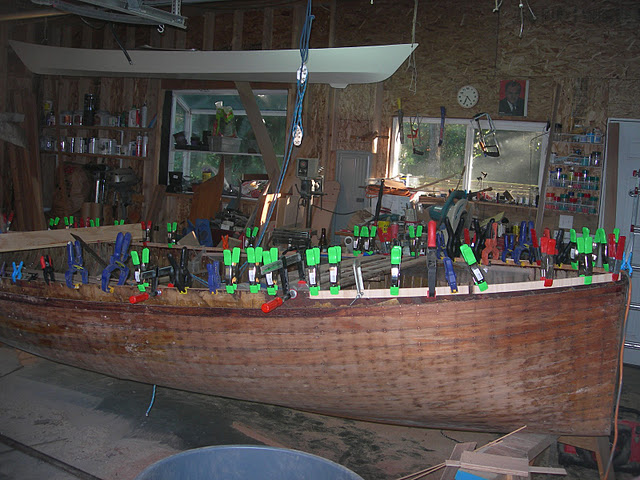
I bought #112 a little over a year ago and set out to maker 'er sail again. The boat was largely complete, but was in pretty worn shape. It was a basket, a double-planked hull with "oiled silk (think umbrella) between the layers to give it an hint of being water tight. She was a basket. When I grabbed hold of the transom and gave it a jerk you could see the entire boat flex this way and that.

I soon realized that to "restore" the boat to using its original construction methods - 7,500+ copper clinched nails into 83 steam-bend ribs - could never be accomplished in my life time. So, I decided "rebuild" the boat using West System epoxy and turn it into a practical, sailable boat for 1-2 people. BLAPHOMEY (sp?)! When I first broached the approach on a wooden boat blog I thought they'd hunt me down and crucify me!

Please feel free to use my photos. I'd love to know who built my boat and when. I suspect that it might have been built by Sandy Douglass before the much more cost-effective hot-molding process came along, but I can't be sure. Two distinguishing features on my boat: The next to the closest plank next to the rail was (and is) a contrasting, darker color. Also, the sail insignia doesn't have a straight line under the 14, it's more of a mushed "caret" - a shallow "V". Any and all information on the origins of "Maureen" - my departed Grandmother - would be greatly appreciated.

My reply;

I looked in my archives. US119 was built in 1940 by Sandy Douglas and was listed as a Uffa One Design (this was the Alarm hull design that would become the basis of the Jet 14 class). I would think your hull is close in age to those dates.

The latest Woodenboat has a continuing series on Uffa Fox. I didn't realize that Sandy Douglass beat Uffa to hot moulding hulls. Sandy Douglass wrote an autobiography "Sixty years before the mast". I haven't read it but I did check Wikipedia which has Sandy getting into boatbuilding in 1938. Int 14 US 112 was built in the pre-war Uffa Fox method, diagonal planking sandwiching a waterproof fabric inner layer so if you have a Sandy Douglass boat, it was one of the early ones that Sandy built.

The assumption is that Sandy used Uffa's building methods until he was able to utilize the WWII developed hot moulding techniques. I think there are probably some people out there that know Sandy's history better than I. I wonder where Sandy's archival history went?