In 2002. seven years before I started this blog, Bob Schock wrote a short piece for Woodenboat about the restoration of International 14 U.S. 34, another bones 14 based out of a small lake in New York. At the time I took note, but this restoration remained tucked in the back of my brain until Bob joined in via email on the discussion of the origin of U.S. 107 and my memory was jolted.
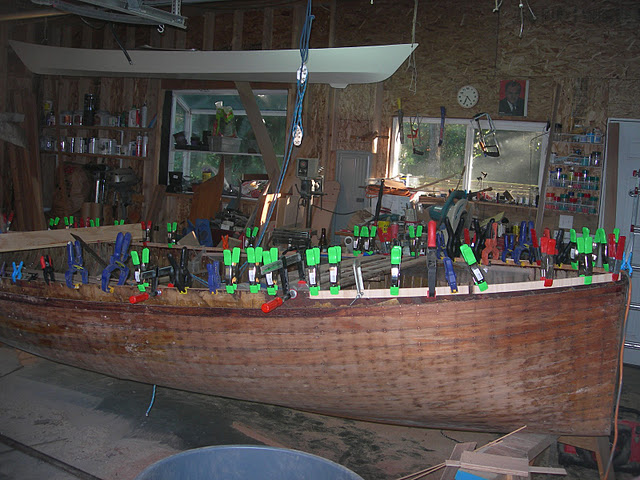
U.S. 34 appears to be an Englert R.I.P purchased from Cape Cod Shipbuilding in the late 1930's. I reprint below Bob Schock's amended article on the origin and restoration of U.S. 34:
Showing posts with label Ribbed Construction. Show all posts
Showing posts with label Ribbed Construction. Show all posts
Thursday, August 11, 2016


Thursday, February 23, 2012
Picture of a Pre-War Ribbed Bourke
Peter Sly of the Prince Edward Yacht Club in Picton, Ontario, sends along this photo of a pre-war ribbed constructed Bourke International 14 (probably built in 1936 or 1937). Photo was taken in 1956 on one of the PEYC docks. Those pre-war International 14's were just gorgeous craft (see the rebuilding of US 112).


Friday, November 25, 2011
Another pre-WWII 14
When it rains it pours........
John Kutz from Kirkland Washington sends pics of another pre-World War II Uffa International 14 that he is now in the process of donating to the Center for Wooden Boats. Has the bazillion steamed ribs and the cross planked construction, which I assumed to be early Sandy Douglass construction that copied Uffa (turns out I was wrong, see below). John has no record of the number assigned to this International 14.
UPDATE: After seeing this post, Stephen Smith sent me an email and correctly points out that this 14 IS NOT an Uffa design. Stephen writes;
Some pictures;


John Kutz from Kirkland Washington sends pics of another pre-World War II Uffa International 14 that he is now in the process of donating to the Center for Wooden Boats. Has the bazillion steamed ribs and the cross planked construction, which I assumed to be early Sandy Douglass construction that copied Uffa (turns out I was wrong, see below). John has no record of the number assigned to this International 14.
UPDATE: After seeing this post, Stephen Smith sent me an email and correctly points out that this 14 IS NOT an Uffa design. Stephen writes;
"Take a look at the shape of the transom. See how rounded the bottom is right down to the centerline. I doubt very much this is an Uffa Fox design, it looks much more like a Morgan Giles design or other from the very late 1920's or early-to-mid 1930's. The Canadians were also building sloop-rigged boats by then, but I think they were clinker-built, so this can't be one of those. It is FOR SURE not a Douglas boat built to Alarm's lines. The bottom is much deeper and rounder. No planing surface on the back. The interior arrangement is also more typical of the Brit's in the early 1930's - not at all like a Douglas boat -- although of course someone could have changed all the interior layout. But the transom shape is a real give-away.Hmmm..... I wonder what design we have here?
The other Carvel-boat US112 shown from Nov. 11 on the blog is, for sure, one of Douglas' early boats, before he started hot-molding them."
Some pictures;


Friday, November 11, 2011




US 112 in Mukilteo Washington
Mark Woodard writes;
My reply;
I bought #112 a little over a year ago and set out to maker 'er sail again. The boat was largely complete, but was in pretty worn shape. It was a basket, a double-planked hull with "oiled silk (think umbrella) between the layers to give it an hint of being water tight. She was a basket. When I grabbed hold of the transom and gave it a jerk you could see the entire boat flex this way and that.
I soon realized that to "restore" the boat to using its original construction methods - 7,500+ copper clinched nails into 83 steam-bend ribs - could never be accomplished in my life time. So, I decided "rebuild" the boat using West System epoxy and turn it into a practical, sailable boat for 1-2 people. BLAPHOMEY (sp?)! When I first broached the approach on a wooden boat blog I thought they'd hunt me down and crucify me!
Please feel free to use my photos. I'd love to know who built my boat and when. I suspect that it might have been built by Sandy Douglass before the much more cost-effective hot-molding process came along, but I can't be sure. Two distinguishing features on my boat: The next to the closest plank next to the rail was (and is) a contrasting, darker color. Also, the sail insignia doesn't have a straight line under the 14, it's more of a mushed "caret" - a shallow "V". Any and all information on the origins of "Maureen" - my departed Grandmother - would be greatly appreciated.
My reply;
I looked in my archives. US119 was built in 1940 by Sandy Douglas and was listed as a Uffa One Design (this was the Alarm hull design that would become the basis of the Jet 14 class). I would think your hull is close in age to those dates.
The latest Woodenboat has a continuing series on Uffa Fox. I didn't realize that Sandy Douglass beat Uffa to hot moulding hulls. Sandy Douglass wrote an autobiography "Sixty years before the mast". I haven't read it but I did check Wikipedia which has Sandy getting into boatbuilding in 1938. Int 14 US 112 was built in the pre-war Uffa Fox method, diagonal planking sandwiching a waterproof fabric inner layer so if you have a Sandy Douglass boat, it was one of the early ones that Sandy built.
The assumption is that Sandy used Uffa's building methods until he was able to utilize the WWII developed hot moulding techniques. I think there are probably some people out there that know Sandy's history better than I. I wonder where Sandy's archival history went?
Subscribe to:
Posts (Atom)